Mealtime adventures are better with Bibado! Let our award-winning products make a difference to your weaning journey.
 Shop Now


CART
Your cart is empty
Mealtime adventures are better with Bibado! Let our award-winning products make a difference to your weaning journey.
Shop Now
When babies begin weaning, many parents understandably focus on minimising the mess. We wipe sticky hands, retrieve dropped spoons, clean faces between mouthfuls and try to keep food on the plate where possible. We do it because mess feels like the problem.
But what if, by focusing only on containing it, we risk overlooking what is actually happening?

What if one of the richest learning opportunities in your baby’s day was also the one you were working hardest to control?
When babies begin weaning, many parents understandably focus on minimising the mess. We wipe sticky hands, retrieve dropped spoons, clean faces between mouthfuls and try to keep food on the plate where possible. We do it because mess feels like the problem.
But what if, by focusing only on containing it, we risk overlooking what is actually happening?
A baby squeezing avocado between their fingers, spreading yoghurt across their tray or turning a piece of broccoli around in both hands is not simply playing with their food. They are taking part in an extraordinarily rich sensory and physical learning experience.
Mealtimes combine touch, taste, smell, sight, sound, movement, balance and body awareness—often all at once. Few everyday activities ask so much of a baby’s developing brain and body simultaneously.
And, as weaning progresses, they may have the opportunity to practise these skills several times every day.
Mess is not an interruption to that learning. Very often, mess is what learning looks like, and that’s exactly why we ‘embrace the mess’ at Bibado.
Food is unpredictable. It can be smooth, grainy, sticky, slippery, firm, crumbly, wet or dry. It changes shape when pressed, breaks apart when pulled and moves differently depending on how it is held.
For an adult, these qualities are familiar. We already know that a raspberry will collapse under pressure, toast needs a firmer grasp, and yoghurt cannot be picked up in the same way as a carrot stick.
A baby does not know any of this yet. They have to discover it through direct experience, and that requires a lot of brain power, sensory processing and skill building.
When your baby touches, squeezes, smells, mouths and tastes food, information is arriving through several sensory systems at the same time. Their brain must receive that information, organise it and connect it with what their body is doing.
This is multi-sensory learning—and mealtimes provide it in abundance.
Sensory awareness begins before the first bite. Eating does not begin when food is swallowed.
Before your baby can confidently accept and eat a food, they first need to understand something about it.
What happens when I touch it?
Is it cold or warm?
Does it feel wet, dry, lumpy or smooth?
How does it smell?
What happens when it reaches my lips or tongue?
Touching and manipulating food allows your baby to gather information before it enters their mouth. This can make an unfamiliar food feel more predictable and give them time to prepare for its texture, temperature and consistency.
A baby who squashes a new food without eating it has not necessarily failed to engage with the meal. They may be building sensory familiarity with it.
Looking, touching, smelling, licking, tasting, chewing and swallowing can all be stages in the process of learning about food and should all be considered ‘an exposure’ in their own right.
During early development, the brain is remarkably adaptable. It changes in response to repeated experience—a process known as neuroplasticity.
Every time your baby reaches for food, adjusts their grip, brings it towards their mouth or responds to its texture, groups of brain cells are activated together.
Repeated experiences help the brain strengthen useful pathways and coordinate information between sensory and motor systems.
Your baby may be learning to connect:
This is sometimes described as neural mapping. The brain is gradually creating more detailed internal maps of the body, the mouth and the sensory qualities of different foods.
Young infants can even transfer information between senses—for example, recognising visually something they have previously explored through touch or with their mouth. This ability to connect sensory information develops through experience.
The brain does not build these maps through explanation. It builds them through repeated action and feedback.
Messy mealtimes do not engage the senses in isolation. They ask multiple systems to work together.
As your baby reaches for a piece of food, their eyes locate it while their body stabilises in the highchair. Their shoulder and arm guide the reach. Their hands judge shape, weight and texture. Their fingers adjust their grasp. Their brain monitors where the food is in relation to their body.
If the food reaches their mouth, another complex sequence begins.
The lips, cheeks, tongue and jaw must respond to its size, texture and position. Your baby has to work out how to move it around the mouth, whether to bite or squash it, and how to prepare it for swallowing.
At the same time, they are processing taste, smell, temperature and sound.
This combination makes self-feeding a substantial sensorimotor task: sensory information guides movement, and movement creates more sensory information.
Touching the food informs the grasp. The grasp changes the food. That change provides new information, prompting another adjustment.
It is an ongoing conversation between the brain, body and environment.
No baby masters eating after one attempt.
They learn through hundreds of small repetitions: reaching, grasping, dropping, retrieving, licking, biting, chewing, scooping and trying again.
At first, these movements are likely to be inefficient. Food gets crushed. Loaded spoons turn over. Cups are pushed rather than lifted. Hands miss mouths.
But repeated practice helps the brain and body become better coordinated.
Movements that initially require enormous concentration gradually become more controlled and automatic. The baby who once spread every spoonful across the tray may eventually learn to guide the spoon accurately towards their mouth.
Because meals are repeated every day, weaning offers regular opportunities to revisit these skills.
Depending on their age and stage, babies may eat complementary foods two, three or more times a day. That can mean multiple daily opportunities to practise sensory processing, coordination, oral-motor skills and independent problem-solving. WHO guidance recommends complementary foods two to three times daily from six to eight months, increasing to three to four times daily from nine months for breastfed children.
Few activities are repeated so frequently, involve so many sensory systems and carry such an immediate reward.
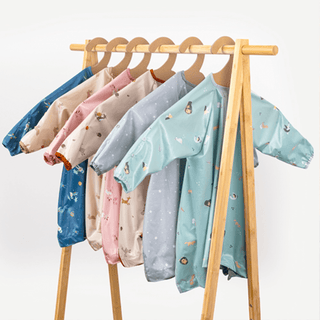
Mess aversion is understandable, but there’s lots you can do to overcome it. It’s one of the main reasons we invented the Coverall Weaning Bib in the first place. It’s only later that we began to realise the enormous developmental benefits it brings by allowing babies and toddlers to explore without limits.
Problems can arise when preventing mess becomes more important than allowing the baby to participate.
Constantly wiping hands, removing food as soon as it is squashed or directing every spoonful into the mouth can interrupt the sensory feedback a baby receives. It may also reduce opportunities to practise reaching, grasping and self-feeding.
Some babies can become distracted or upset when their hands and faces are repeatedly wiped. Others may begin to learn that certain textures should be removed immediately rather than safely explored.
A baby cannot learn to tolerate sticky, lumpy, wet or crumbly sensations without encountering them. Sensory awareness develops through exposure—not avoidance.
This does not mean deliberately overwhelming a baby or ignoring signs of discomfort. Sensory confidence is best supported gradually, responsively and without pressure. The goal is to create safe opportunities for exploration while respecting the individual baby’s cues.
Food confidence is not simply the willingness to swallow whatever is offered.
It begins with feeling safe enough to investigate.
When babies are allowed to touch, smell and manipulate food without being rushed to eat it, they can learn about it at their own pace. Repeated exposure helps unfamiliar sensations become more predictable.
Today, your baby may only look at the food.
Next time, they might touch it.
Another day, they may bring it to their lips.
Eventually, they might taste, chew and swallow it.
Each interaction adds to their sensory understanding.
This is why a meal can be successful even when very little food has been eaten. Exploration is not separate from learning to eat; it is often an essential part of the pathway towards it.
As new parents, we are rarely told that mess can have developmental value.
We are more likely to encounter products, advice and social expectations focused on keeping babies, clothes and kitchens clean. As a result, it is easy to see mess as evidence that a meal has gone wrong.
But messy mealtimes offer something uniquely valuable.
They allow babies to see, smell, touch, taste, move, experiment and problem-solve simultaneously. They support the brain as it builds connections between sensory information and physical action. They help babies create internal maps of food, their bodies and their mouths.
And they offer the chance to repeat that learning, meal after meal.
The goal is not to create mess for the sake of it. Nor is it to make family life more difficult.
It is to recognise that when babies are given safe, supported freedom to explore food, mess often carries valuable information.
So perhaps the question is not, “How can you stop your baby making so much mess?”
Perhaps it is:
“How can I manage the mess without removing the opportunity?”
Because your baby is not just making a mess. They are building a brain and body that are learning how to eat.

Hot Weather and Tiny Appetites: What Parents Need to Know
Hot weather can bring a whole host of feeding worries for parents, and one of the most common is a sudden drop in appetite. To help explain what's going on, we've asked Bibado's resident Paediatric...
Read more
What Happens Inside Your Baby's Brain During a Messy Mealtime?
To you, it looks like lunch, breakfast or dinner. For your baby's brain, it's one of the richest developmental workouts of the day. Every time they squash a raspberry, reach for a spoon, smell a pi...
Read moreFollow us for more delicious, nutritious bite-size Bibado goodness
