Mealtime adventures are better with Bibado! Let our award-winning products make a difference to your weaning journey.
 Shop Now
CART
Your cart is empty
Mealtime adventures are better with Bibado! Let our award-winning products make a difference to your weaning journey.
Shop Now
Pouches can be brilliant. They’re quick, convenient, and often exactly what you need when life is happening at full speed. But when it comes to learning how to eat, they only tell part of the story.
Because weaning isn’t just about swallowing food; it’s about everything babies do with food before it even reaches their mouth.
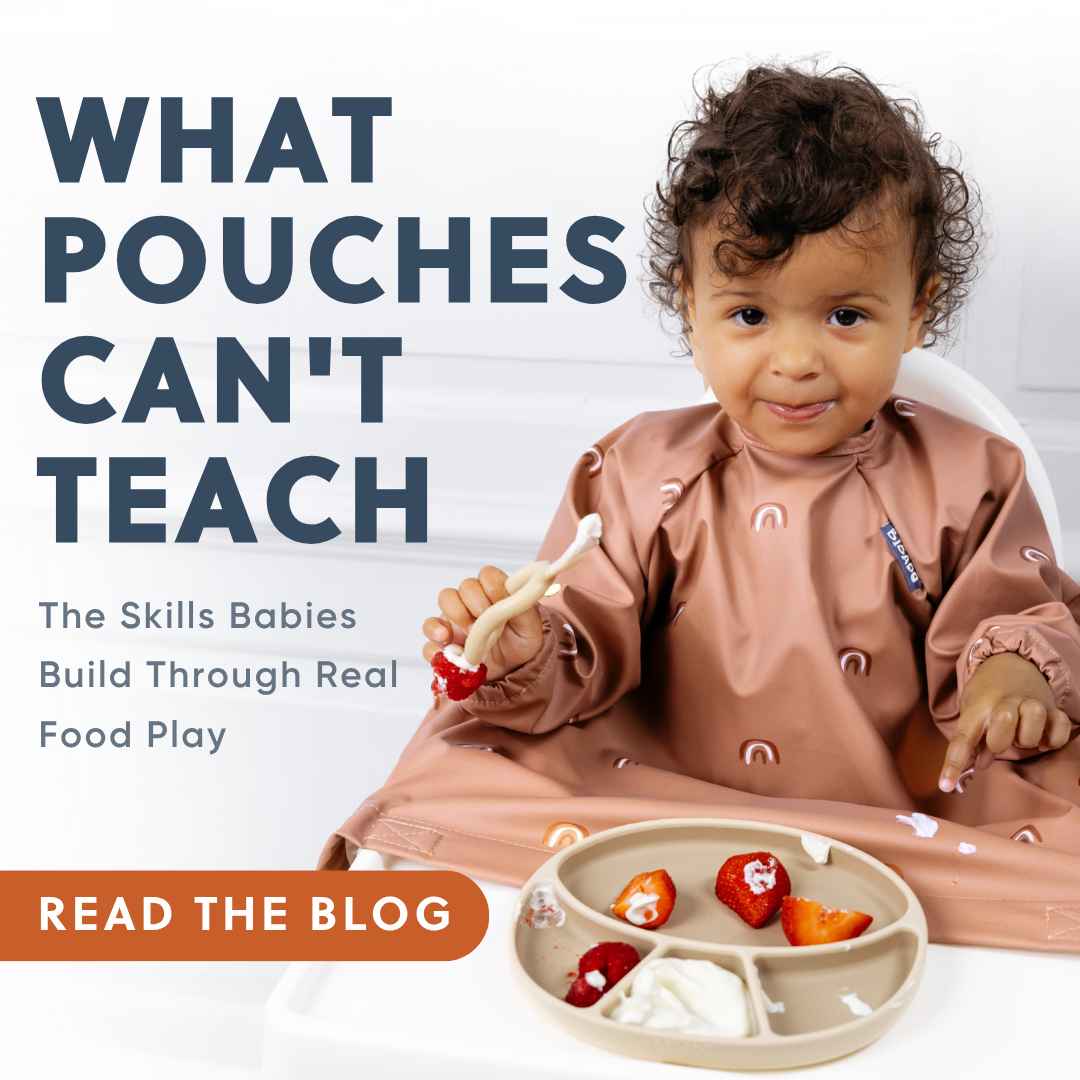
Pouches can be brilliant. They’re quick, convenient, and often exactly what you need when life is happening at full speed. But when it comes to learning how to eat, they only tell part of the story.
Because weaning isn’t just about swallowing food; it’s about everything babies do with food before it even reaches their mouth.
At Bibado, we see messy mealtimes as the most meaningful ones. The squish, the smear, the triumphant handful of pasta - it’s all learning in action.
For babies, eating is a full-body experience.In fact, it's one of the rare moments where all of their senses are firing simultaneously. And it happens several times a day. That's a lot of opportunities for learning and development!
Before anything gets tasted, it gets touched, squashed, dropped, sniffed and studied like it’s the most fascinating thing in the world (because to them, it is).
Real foods invite this kind of exploration in a way pouches simply can’t. With a pouch, it’s mostly taste and swallow. With real food, your baby is engaging a multitude of senses - sight, touch, texture, smell, and taste. This full-immersion discovery nurtures familiarity and confidence, facilitating vital skill-building and furthering their cognitive development.
Babies don’t just “know” how to chew - it’s a learned skill.
Exposure to different textures helps to develop jaw strength, tongue coordination and the oral-motor skills needed for more complex eating later on, among lots of other things.
So even if that broccoli spear gets waved around, smashed, or eventually dropped on the floor, those crucial attempts to bite and mouth it are still valuable practice.
Every piece of food picked up is a mini gym session for fine motor skills.
Grasping slippery pasta, pinching soft fruit, and guiding food to the mouth all build hand-eye coordination and contribute to the pincer grip they’ll later use for writing, drawing, and dressing themselves (future you will thank them).
Food just happens to be one of the most motivating “toys” they’ll ever meet! And when some foods prove a little too slippery, squishy or tricky to manage, simple utensils can help keep babies engaged in the action. Tools like the Bibado Sporkit give little hands another way to explore and self-feed, helping them stay involved in the learning rather than waiting to be fed.
Self-feeding isn’t just about eating; it’s about ownership and independence.
When babies explore food themselves, they begin to understand choice, control, and their own hunger and fullness cues.
It’s the start of confidence at mealtimes… even if it looks a bit chaotic in the moment.
Think of your little mealtime adventurer as a mini detective.
That yoghurt on the tray? It’s been examined. The cucumber batons tossed on the floor? Investigated.
What looks like mess is often a baby running very thorough sensory experiments. Every squish and smear is helping them build a mental library of textures, tastes and reactions.
They'll store this data and refer back to it on future exposures, helping them to recognise and accept a wide variety of tastes and textures.
Like everything in parenting life, it's about balance. Pouches aren't off the menu. We recognise they're portable, convenient and sometimes, the practical solution you need in the moment.
But as often as you can, offering real foods that babies can hold, explore, and self-feed gives them something pouches can’t: the full learning experience.Watermelons, parsnips and beetroot aren't squeezed out of pouches in real life. If we default to pouches too often, we skip an important part of the weaning process, and in extreme cases, it can lead to delays in motor development and skill-building. This can lead to picky eating and delayed speech.
It's also worth remembering that it's the early introduction of texture that helps your little one mentally map their mouth and figure out how to move food around it. This is actually a safety mechanism that shifts the gag reflex towards the back of the mouth to allow safe swallowing.
So, there are some really powerful and practical reasons to incorporate real-food play as often as possible.

Pros and Cons: Do Coverall Bibs Really Work?
If you’re in the messy phase of baby‑led weaning, you may have heard about coverall bibs — the full‑coverage bibs with sleeves that go beyond a standard bib. But you might be wondering: Do they act...
Read more
Your Baby’s Mealtime Toolkit: 7 Skills They’re Building Right Now
Your baby isn’t simply learning how to finish a meal. They’re developing increasingly complex motor, sensory and feeding skills that will help them become more capable and independent as they grow.
Read moreFollow us for more delicious, nutritious bite-size Bibado goodness
