Mealtime adventures are better with Bibado! Let our award-winning products make a difference to your weaning journey.
 Shop Now
CART
Your cart is empty
Mealtime adventures are better with Bibado! Let our award-winning products make a difference to your weaning journey.
Shop Now
Article: Could Self-Feeding Help Your Baby Learn to Talk?
Could learning to feed themselves help babies develop their communication skills? Fascinating new research has uncovered a surprising connection between self-feeding and early language development. We explore what scientists discovered and what it could mean for your baby's mealtimes.
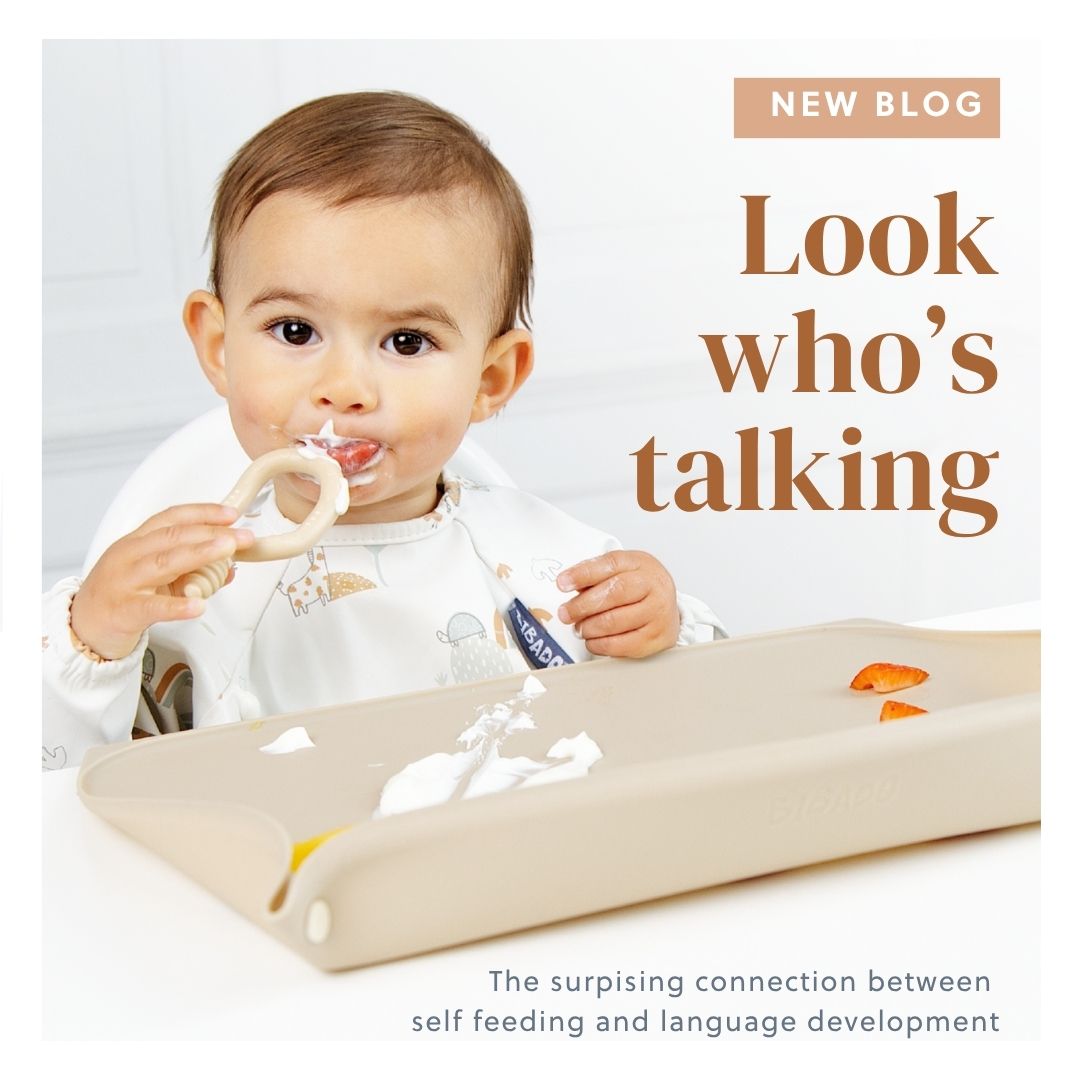
New research has uncovered a surprising connection between self-feeding and early communication. And it might change the way you think about what happens at the highchair.
There's a lot going on when a baby learns to feed themselves.
Some of it is obvious. The determination to pick up a slippery piece of banana. The concentration involved in bringing a spoon to their mouth, not to mention the satisfaction of finally succeeding.
But something far less obvious might also be happening.
Researchers have discovered an intriguing connection between babies who feed themselves and how their early communication skills develop.
And it suggests that mealtimes might be doing even more developmental work than we realised.
In a 2026 study published in Child Development, researchers followed 182 babies, observed their eating and communication behaviours at around 12 months, then tracked their language development through to 24 months.
They found that babies who fed themselves more frequently were also more likely to communicate through gestures and vocalisations during mealtimes.
But here's where it gets particularly interesting.
Babies who showed more independent eating at 12 months were associated with greater sentence production at 24 months.
Importantly, this was an observational study. It doesn't prove that self-feeding causes babies to talk earlier. And the researchers didn't find the same relationship with vocabulary size.
What it does reveal is a fascinating association between two developmental processes we might not instinctively connect.
Think about what happens when your baby is actively participating in a meal.
They might reach towards a food they want. Look at you for a response. They might make a sound to get your attention. Hold something up to show you. Or offer you a piece of their dinner.
These aren't just feeding behaviours. They're also crucial opportunities for communication.
One particularly lovely finding from the study was that almost 40% of the babies offered their own food to another person during the observed meal.
It's a small action, but one that illustrates something important that we talk a lot about at Bibado.
For babies, mealtimes aren't just about consuming food. They're social experiences, full of opportunities to communicate before they have the words to do so.
The researchers also observed connections between mothers talking to their babies during meals and the babies' own communication behaviours.
Of course, there's still lots to understand about how these different skills develop together. But it's a compelling reason to think about feeding as something babies actively participate in, rather than something that simply happens to them.
NHS guidance already recommends giving babies opportunities to take an active part in feeding.
That doesn't mean abandoning spoon-feeding, or expecting every baby to manage independently from the outset.
It might mean offering age-appropriate finger foods, letting your baby hold a spoon, responding when they gesture towards something, or simply making time to sit and eat together.
While they practise those emerging eating skills, there's another valuable opportunity: talking to them, noticing their attempts to communicate and responding to their cues.
The aim isn't to turn every meal into a developmental exercise. Or to worry about whether your baby is saying enough words.
It's to recognise that everyday mealtimes can offer rich opportunities for learning and connection.
At Bibado, we've always believed that learning to eat deserves more thought.
It's why we work alongside paediatric feeding experts to understand how babies develop their skills, and why we design products that support their growing ability to participate in mealtimes.
This latest research gives us another fascinating perspective.
The little person concentrating on picking up their lunch isn't just learning to feed themselves. They're also interacting, exploring and finding new ways to make themselves understood.
And sometimes, the most interesting thing happening at the dinner table has very little to do with the food.
We asked our friend and Specialist Paediatric Dietitian, Lucy Upton what she wished more parents understood about letting babies actively participate in mealtimes, and this is what she had to say
"What I love about this study is that it reinforces something I see every day in clinical practice: feeding is something a baby does, not simply something that's done to them.
As parents, it's natural to focus on the nutritional side of mealtimes. How much has my baby eaten? Are they getting enough? But when I observe a baby eating, I'm also watching a child developing an extraordinary range of skills.
And those self-feeding skills really matter.
One of the most valuable things we can do is give babies the opportunity to practise. That means sitting alongside them, showing them how things work, offering support when they need it, but also knowing when to step back and give them space to try.
There's so much learning in that wonderful process of trial and error. Putting food into their mouths, spitting it back out, learning to bite, manipulate and chew. It might not always look like progress, but it's an essential part of how these skills develop.
And if your baby isn't particularly interested in feeding themselves just yet, please don't worry. Like any developmental milestone, these skills emerge at different rates. A little extra support, plenty of modelling and opportunities to practise can all help.
If you have concerns about your baby's feeding or speech development, do speak to your health visitor.
Ultimately, we need to create the space for babies to learn. Sometimes that means showing them what to do, and sometimes it means stepping back so they can discover what they're capable of."
Pecora, G. et al. (2026). Self-feeding and communicative development from 12 to 24 months of age: An observational study. Child Development, 97(1), 21–37.
NHS. Your baby's first solid foods.

Your Baby’s Mealtime Toolkit: 7 Skills They’re Building Right Now
Your baby isn’t simply learning how to finish a meal. They’re developing increasingly complex motor, sensory and feeding skills that will help them become more capable and independent as they grow.
Read moreFollow us for more delicious, nutritious bite-size Bibado goodness
